
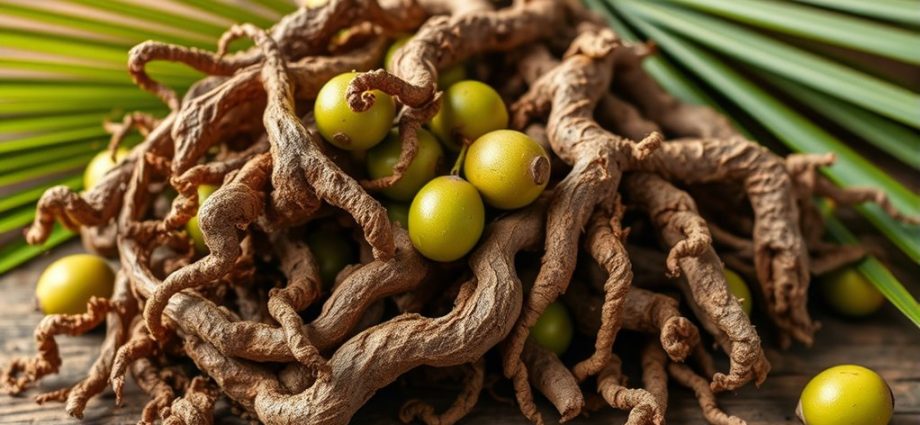
You’ll find acai roots form a fibrous network that stabilizes the palm in Amazon floodplains and aids nutrient absorption essential for fruit growth. Although not edible, these roots play an important ecological role and are traditionally used in folk medicine, hinting at bioactive compounds like tannins. Their full chemical and nutritional profiles remain underexplored, leaving open opportunities for sustainable applications and medicinal discoveries. Exploring their potential reveals intriguing insights into acai’s biology and utility.
Although acai palms are primarily studied for their nutrient-rich fruits and edible hearts of palm, the roots play an essential, yet underexplored, role in the plant’s biology and utility. You’ll find that acai roots belong to a fibrous root system characteristic of tropical palms, specifically adapted to the Amazon floodplains where the palms grow. These roots anchor the multiple-stemmed palm, which can reach heights of 15 to 30 meters with 4 to 8 stems around 20 centimeters in diameter each.
This fibrous root network not only stabilizes the tall and slender plant against the dynamic forces of flooding but also facilitates effective absorption of nutrients and water in the frequently saturated soils of the Amazon basin. Despite their central ecological function, detailed morphological and anatomical studies on acai roots remain sparse, leaving much of their structural complexity and biochemical makeup to be further clarified. Traditional harvesting practices reflect respect for sustainability and Mother Nature, with methods minimizing waste and promoting eco-conscious agriculture, which may extend to root management as well.
Acai’s fibrous roots anchor and nourish the palm in Amazon’s flood-prone, nutrient-rich soils.
You should note that indigenous Amazonian communities have long recognized the roots’ functional significance beyond stability. While scientific literature prioritizes the fruits and leaves, ethnobotanical evidence indicates that acai roots form a component of traditional medicinal practices. Root decoctions and poultices are reportedly used in folk medicine, suggesting potential anti-inflammatory or antimicrobial applications.
Though documentation is limited and systematic phytochemical studies are lacking, traditional uses insinuate the presence of bioactive compounds within the roots, distinct from the well-studied antioxidant-rich fruit. Consequently, the roots contribute to a holistic utilization framework of the acai palm in indigenous ethnomedicine, offering therapeutic options for local ailments based on centuries of experiential knowledge.
From a culinary perspective, the roots themselves aren’t harvested or processed as a food source. You won’t find acai roots entering mainstream food products, as the edible portions remain focused on the fruits and the hearts of palm. Nevertheless, by supporting the palm’s structural integrity and health, the roots indirectly enable the fruit production essential to regional diets and the global acai market.
In addition, the root systems likely play a role in environmental sustainability—stabilizing soil on flood-prone land and maintaining the ecological balance necessary for successful cultivation or natural regeneration. Occasionally, small segments of the root might be utilized locally, possibly as fuel or in artisanal craftwork, though these uses are marginal compared to the more versatile applications of leaves and stems. This also ties into the broader sustainability journey of the acai industry that emphasizes ecological balance.
Regarding the nutritional and chemical profiles of acai roots, your available scientific data will be limited. Unlike the fruit, which contains high levels of antioxidants, fatty acids, and phenolic compounds, root analyses remain preliminary and incomplete.
It’s probable that the roots contain fibrous material typical of palm roots and may produce secondary metabolites such as tannins or other phenolics, but exact concentrations and compound identities await future in-depth studies. This knowledge gap means that the roots’ potential for commercial nutraceutical or pharmaceutical use is largely unexplored, representing an opportunity for further research to reveal new applications.
Conclusion
Now that you know acai roots support the acai palm’s stability and nutrient transport, it’s worth questioning if their bioactive compounds could offer untapped health benefits. While acai pulp is widely praised, the roots remain less studied, suggesting a potential frontier in natural remedies. Exploring these roots in detail might reveal antioxidants or anti-inflammatory properties, inviting you to reconsider what parts of the plant hold valuable uses beyond what’s commonly known.