
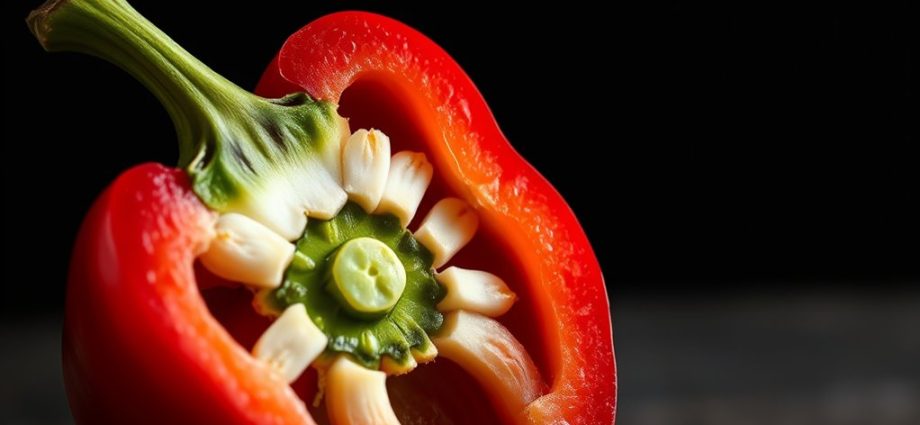
You might think peppers are vegetables, but botanically, they’re fruits because they develop from the flower’s ovary and contain seeds needed for reproduction. In culinary terms, their firm texture and savory flavor place them with vegetables, used in savory dishes. Capsaicin presence doesn’t change their botanical class. This dual identity arises from scientific classification versus culinary usage, revealing how peppers uniquely bridge both categories. Exploring this distinction further will clarify why.
When you examine peppers through a botanical lens, the key features that define fruits become clear: they originate from the flower’s reproductive structure, the ovary, and bear seeds essential for propagation. This criterion excludes edible plant parts such as roots, stems, and leaves, which are classified as vegetables because they lack seed-bearing capacities. For example, carrots and celery are vegetables despite frequently sharing plate space with fruits like peppers. Your understanding of peppers as fruits aligns strictly with their biological role in the plant’s reproductive cycle rather than their culinary use. Botanically, peppers are part of the nightshade family, which also includes tomatoes, eggplants, and potatoes—all considered fruits. This classification is consistent with the fact that peppers contain seeds, meeting the botanical criteria for fruit. Botanical Classification
Peppers are fruits botanically, developing from the flower’s ovary and containing seeds for reproduction.
In everyday culinary contexts, however, peppers are almost universally categorized as vegetables. This classification arises from sensory characteristics—such as their savory flavor profile, firm texture, and typical incorporation into savory dishes—which contrast sharply with the sweet taste profiles generally associated with culinary fruits like apples or berries. Green bell peppers, which are unripe, exhibit more bitterness and low sugar content, reinforcing their vegetable-like standing in cooking. As a result, chefs and home cooks typically group peppers alongside other vegetables, affecting marketing and consumer expectations within grocery environments.
The distinctions between botanical and culinary classifications originate from fundamentally different priorities. Botanists prioritize reproductive anatomy and seed dispersal methods to classify plant parts. In contrast, culinary classifications hinge on taste, texture, and usage within recipes. This divergence creates widespread confusion and contributes to frequent misidentifications of common produce. Peppers, tomatoes, cucumbers, and eggplants exemplify this phenomenon where botanical truth conflicts with everyday language.
Capsaicin, the compound responsible for the characteristic pungency in chili peppers, doesn’t influence botanical classification. Bell peppers, which lack capsaicin, remain classified as fruits regardless of their absence of heat. While capsaicin strongly affects culinary applications—prompting categorization of pungent peppers as spices or savory ingredients—it plays no role in defining their position in plant taxonomy.
Understanding peppers in relation to other produce helps clarify this complex categorization. Like peppers, tomatoes, cucumbers, and olives develop from flowers and contain seeds, meaning they’re all fruits botanically. Nonetheless, their firm textures and savory taste cause them to be treated as vegetables within meal preparation. This dual identity highlights the importance of distinguishing between scientific taxonomy and culinary tradition to appreciate why peppers are fruits by nature yet vegetables by common usage.
Conclusion
You’ve peeled back the layers of peppers’ identity and discovered their botanical truth: they’re fruits, not vegetables. Just as a scientist decodes DNA to reveal life’s blueprint, you’ve unraveled the pepper’s classification by its seeds and flowering origins. Though culinary traditions dress them as vegetables, remember that biology governs their nature. So, next time you slice into a pepper, know you’re handling a fruit cloaked in savory disguise, bridging science with your kitchen craft.
Comments are closed, but trackbacks and pingbacks are open.