
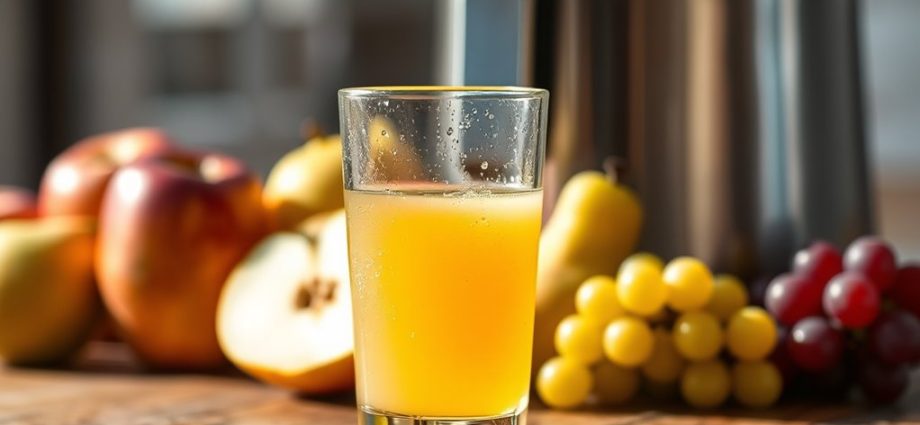
You start making clear fruit juice by selecting ripe, high-quality fruits and thoroughly washing them to avoid contaminants. Next, you extract juice using crushing and pressing techniques, sometimes enhanced by ultrasonic waves. Then, you treat the juice with pectolytic enzymes and conduct careful clarification to remove cloud-causing substances. After that, you filter the juice through multiple stages and stabilize it via heat treatment. The process guarantees clarity, flavor retention, and safety—explore further for detailed steps and innovations.
Clear fruit juice is produced through a series of controlled steps designed to remove solids and impurities while preserving flavor and nutrients. You start with whole fruits, but not all are suitable. You must sort them carefully to select ripe pieces and remove those damaged or unsuitable. A fruit sorting machine helps improve juice quality by removing rotten, diseased, and damaged fruit, ensuring only the best apples are used in production fruit sorting machine.
Clear fruit juice begins with carefully sorted ripe fruits to ensure purity and preserve natural flavor and nutrients
After sorting, fruits undergo thorough washing with clean, often filtered water to eliminate dirt, pesticide residues, and other contaminants. This washing is enhanced with soft brushing or high-pressure water jets to guarantee the fruit surfaces are clean, further safeguarding the juice quality. Stones, seeds, and unwanted peels are removed mechanically or manually, depending on the scale of operation, to prevent off-flavors and contamination.
Once prepared, you move on to juice extraction. Depending on the fruit type, stainless steel crushers or graters break down the fruit to a pulp. The choice of equipment affects yield and quality, so you must tailor this step carefully. Next, pressing separates the juice from the solid pulp. Controlled extraction temperature is critical here; maintaining it carefully optimizes juice extraction without compromising quality. Additionally, during these early stages, mass transfer processes such as maceration and depectinization begin to improve juice extraction. Stainless steel crushers and spiral juice extractors are often used to maximize juice yield and purity.
Recently, technologies like ultrasonic waves have been introduced. These waves more efficiently break down cell walls, boosting yield beyond conventional mechanical methods. However, the extracted juice still contains pulp and suspended solids, necessitating further processing.
You then apply enzymatic treatment to clarify the juice. Adding pectolytic enzymes targets pectin molecules, the primary cause of cloudiness. This enzymatic depectinisation takes place at moderate temperatures between 50 and 60°C—a range that activates enzymes effectively without damaging delicate flavor compounds or nutrients. This step reduces juice viscosity and promotes the formation of flocculants, tiny aggregates that make later separation processes easier and more effective.
Following treatment, you keep the juice cool, often overnight, to suppress unwanted fermentation and maintain stability. Clarification and filtration follow as essential steps to remove suspended solids, cloud particles, and residual pectins.
You might employ flotation devices where microbubbles adhere to flocculants, lifting them to the surface for removal. Subsequently, the juice passes through multiple filtration stages, progressing from coarse meshes to fine filters with pore sizes as low as 0.1 mm. For finer particle removal, centrifugal separators spinning at high speeds enhance clarity considerably. You probably need several filtration cycles to achieve the transparency standards expected of clear juice.
Heat treatment and pasteurization provide microbial stability and shelf life extension. Typically, you heat the juice between 80 and 120°C depending on the fruit and process stage. Higher temperatures are reserved for concentration and sterilization phases. Precise control over both temperature and exposure duration guarantees inactivation of spoilage enzymes and pathogens while retaining maximum flavor and nutrient integrity. For clear juice, the heat transfer schedule often includes initial heating to 55°C for enzymatic treatment and reaching up to 120°C during the pre-concentration phase, ensuring optimal clarity.
Rapid cooling follows heating to halt thermal effects and preserve quality immediately before packaging. In some cases, you also concentrate clear juice by evaporating water under vacuum conditions, reducing thermal damage.
Since aromatic compounds can evaporate during this step, you capture and then reintroduce them to preserve the natural flavor profile. Techniques like centrifugal decanter separation isolate essential oils—such as d-limonene from orange juice—to be handled separately or reincorporated thoughtfully.
Through these rigorously controlled processes, you transform raw fruit into a clear juice that maintains its characteristic flavors, clarity, and nutritional value.
Conclusion
As you finish the process, clear fruit juice stands like distilled sunlight—pure, refined, and free from shadows of impurities. Each step peels away complexity, revealing transparency both literal and symbolic. This clarity symbolizes precision and control, reflecting the meticulous science behind every drop. By mastering these methods, you harness nature’s essence, delivering clarity not just in appearance but in quality, ensuring the final product meets the highest standards of purity and excellence.