
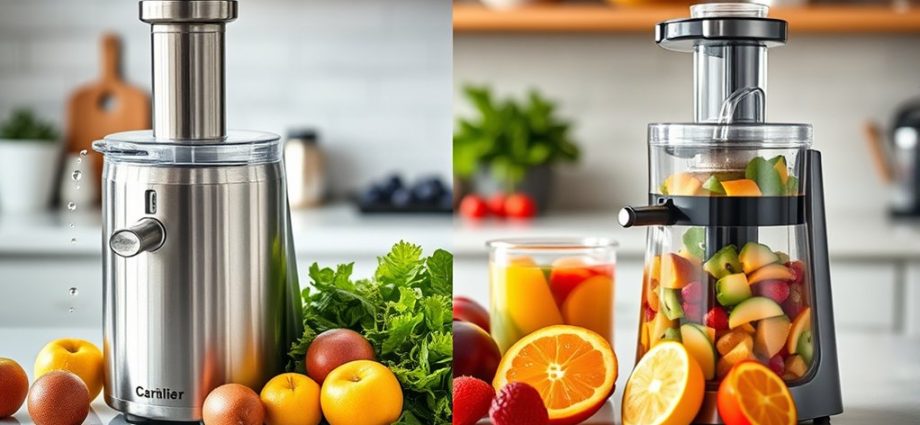
When choosing between a cold press juicer and a regular juicer, you’ll find several key differences. Cold press juicers operate slowly, preserving nutrients and enhancing juice flavor while offering longer shelf life. They extract more juice from leafy greens and tough veggies. Although cold press models cost more upfront, their durability could save you money in the long run. Regular juicers, while more user-friendly, tend to yield less nutrient-rich juice. Discovering these distinctions can greatly enhance your juicing experience.
When you’re choosing a juicer, it’s essential to evaluate the differences between cold press and regular juicers, as each offers unique benefits and drawbacks that can remarkably impact your juicing experience.
Cold press juicers, also known as masticating or slow juicers, operate at a low speed of around 80 to 100 RPM, using slow grinding and pressing methods. On the contrary, regular juicers, or centrifugal juicers, spin at high speeds—ranging from 3,000 to 16,000 RPM—utilizing centrifugal force, which can lead to a more chaotic juicing process.
When it comes to nutrient retention and juice quality, cold press juicers take the lead. Their slow extraction process minimizes heat generation and oxidation, allowing for more vitamins, enzymes, and micronutrients to be preserved in your juice. For example, cold press juicers can retain vitamin A with only a 12% loss, whereas centrifugal juicers can degrade nutrients more rapidly. The cold press juicing process results in a final product that is smooth and fresh, offering better health benefits. Additionally, the minimal heat generation in cold press juicing provides a higher nutrient extraction compared to centrifugal juicers.
You’ll likely notice that juice from a cold press machine has a richer flavor, smoother texture, and less foam than juice from a centrifugal model. This quality is crucial not just for palatability but also for maximizing the health benefits of your juice.
On the topic of juice yield and efficiency, cold press juicers excel by squeezing more liquid from the same amount of produce. If you’re juicing leafy greens or tough vegetables, you’ll appreciate the efficiency of a cold press design that extracts more juice and nutrients without wasting a significant amount of pulp.
While it’s true that you might need to use more produce to achieve the same volume of juice compared to a centrifugal juicer, the end result is often more substantial and nutrient-rich juice, making the investment worthwhile.
Shelf life and storage capabilities also play a critical role in your juicing experience. Cold press juices can remain fresh for 2-3 days under refrigeration due to lower oxidation, while juices from centrifugal machines usually start to degrade within just 24 hours.
This longer shelf life allows for batch preparation, so you can juice ahead of time without worrying about nutrient loss. You’ll find that cold press juice separates less noticeably compared to centrifugal juice, making it easier to store.
When considering operation and ease of use, cold press juicers generally require a bit more time and effort. They often need produce to be pre-cut into smaller pieces prior to juicing, and the process is slower.
However, they do run quietly, which can be a blessing during early mornings. Centrifugal juicers win in the speed department, being user-friendly and requiring less clean-up effort since they’ve fewer parts.
Ultimately, the price and durability of juicers can be a deciding factor. Cold press juicers tend to be more expensive due to their advanced technology but can prove to be a worthwhile long-term investment.
When you weigh the benefits of nutrient retention, juice quality, and shelf life against the higher upfront cost, cold press juicers can take your juicing adventures to a new level.
Conclusion
In the battle between cold press juicers and regular juicers, it’s clear that choosing the right one can be as essential as selecting the right tool for your kitchen craft. If you’re after nutrient-rich juice that retains flavor and freshness, a cold press juicer is your best bet. Conversely, if you prioritize speed and convenience, a regular juicer might suit your lifestyle better. Understanding these differences guarantees you invest in a juicer that aligns with your health goals and daily routine.
Comments are closed, but trackbacks and pingbacks are open.