
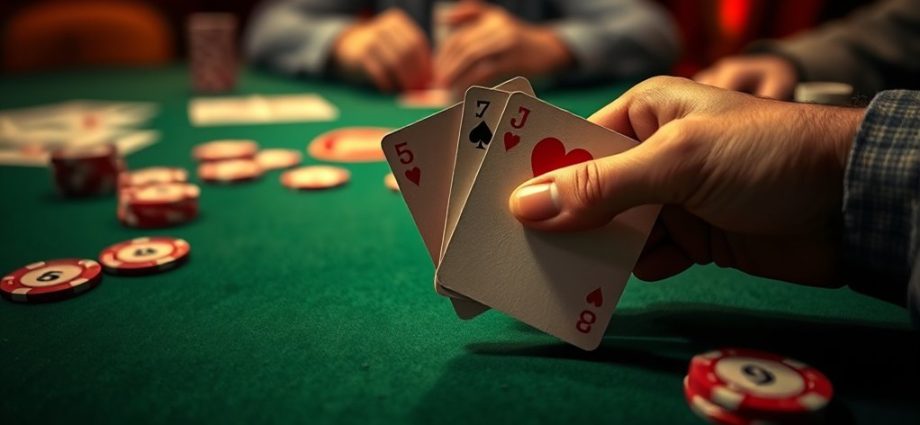
A gut shot in poker is an inside straight draw where you need one specific middle card to complete your straight, giving you only four outs. It’s less likely to hit than an open-ended straight draw, with about a 16% chance on the flop and 8% on the turn. Strategically, gut shots are weaker draws, so you should combine them with other draws or strong position. Mastering gut shots reveals deeper strategic advantages.
A gut shot in poker, also known as an inside straight draw or belly buster, occurs when you need a specific rank in the middle of your sequence to complete a straight. Unlike an open-ended straight draw, which has two possible ranks to complete a straight, a gut shot demands exactly one rank to fit perfectly into your hand’s progression.
A gut shot requires precisely one middle card to complete a straight, unlike open-ended draws with two possible ranks.
For example, if you hold 8-7 and the flop is K-5-4, you’re waiting specifically for a 6 to nail the straight. This concept applies across popular variants like Texas Hold’em, Omaha, and Stud, making it a fundamental element in your hand-reading and strategic arsenal. A gutshot can occur in a variety of poker games where straights are possible, emphasizing its wide relevance in poker strategy.
When it comes to the probabilities surrounding gut shots, understanding your odds is essential. Since you need just one rank and there are four cards of that rank left in the deck, you have 4 outs. This translates to around a 16% chance to complete your straight on the flop and roughly 8% on the turn. In comparison, an open-ended straight draw typically has about eight outs, which gives you approximately twice the chance to hit your straight as a gut shot.
The “Rule of 4 and 2” is an efficient shortcut: multiply your outs by 4 on the flop or by 2 on the turn to estimate your hitting probability. Compared to the open-ended straight draw’s approximate 32% chance with 8 outs, gut shots are clearly a riskier proposition, so you’re playing with thinner margins and must be disciplined.
Strategically, gut shots are generally weaker draws. Chasing them outright without additional backup can drain your chips because the odds aren’t on your side. However, the equation changes when you combine your gut shot with overcards or a backdoor flush draw, as this combination can elevate your overall equity. Additionally, recognizing a double gutshot can create opportunities for more potent betting strategies due to the increased number of outs.
Maintaining aggression when you’re the preflop aggressor allows you to apply pressure and potentially win the pot outright before the draw materializes. Semi-bluffing with a gut shot can be a powerful move if the board texture supports representing a stronger hand, but you should remain cautious.
Completing a gut shot into a non-nut straight can leave you vulnerable against better straights or full houses, so be mindful of the potential threats. Gut shots often serve multiple roles beyond just hitting a straight.
You might fold a gut shot in unfavorable situations due to poor pot odds or lack of supplementary equity, but sometimes leveraging gut shots as bluff or semi-bluff tools can extract value or force folds. In multiway pots, the value of a gut shot depends heavily on your read of opponents’ likely holdings; the complexity of hand ranges can either diminish or enhance your gut shot’s tactical worth.
Combining gut shots with flush draws or two pair can greatly boost your hand’s winning chances, paving the way for more profitable play. The terminology around gut shots varies but consistently underscores the core idea of requiring a “middle” card in the sequence.
“Belly buster” is a colorful colloquial term highlighting the inside nature of this draw. It’s important to distinguish these from open-ended draws, which flank the sequence on either end, providing more outs and better odds. Whether you’re playing Hold’em, Omaha, or Stud, recognizing and correctly valuing a gut shot is integral to solid poker strategy, allowing you to make informed decisions rooted in equity and pot odds rather than guesswork.
Conclusion
A gut shot in poker challenges you, tests your patience, and sharpens your instincts. It demands precise calculation, strategic play, and confident decision-making. When you chase that inside straight, you’re not just hoping—you’re reading opponents, managing risk, and seizing opportunity. Understanding a gut shot’s odds empowers you to play smarter, bet stronger, and fold cleaner. Embrace the gut shot, master its nuances, and elevate your poker game to a new level of expertise.