
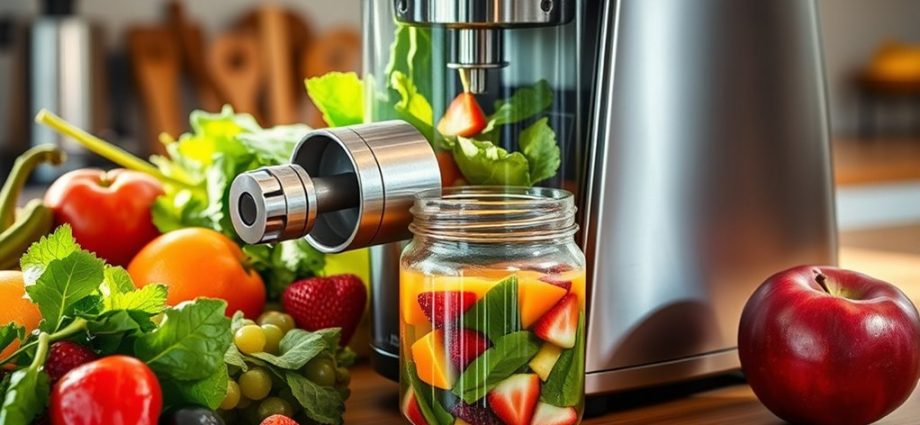
When you use a cold press juicer, it slowly crushes and grinds fruits and veggies to release juice without generating heat or oxidation. This gentle process mimics chewing, breaking down cell walls to preserve vitamins, enzymes, and antioxidants. The low-speed motor guarantees nutrient retention while yielding clear juice with minimal foam and dry pulp. Cold pressing produces more juice and extends freshness compared to centrifugal juicers. You’ll find there’s a lot more behind this efficient, nutrient-preserving method.
Although juicing might seem straightforward, a cold press juicer works through a carefully engineered process that preserves nutrients and enhances juice yield. When you feed fresh fruits and vegetables into its feeding tube or hopper, the produce doesn’t just spin or get chopped quickly. Instead, it undergoes slow crushing or grinding, performed either by a single auger screw or a set of twin gears. This mechanical action mimics chewing, breaking down cell walls gently but effectively, which is key to releasing valuable plant juices without generating heat or introducing excessive oxygen. Before this stage, fruits and vegetables should be properly prepared, including washing and disinfecting and removing stems or peels as needed for optimal pre-crushing preparation.
A cold press juicer gently crushes produce, preserving nutrients by minimizing heat and oxidation.
As the produce is crushed, the cold press juicer applies strong pressure, either with the screw-based system or a hydraulic press. This pressing is gradual, which minimizes heat generation and oxidation that would otherwise degrade vitamins, enzymes, and antioxidants. What you get in return is nutrient-dense juice, extracted efficiently while keeping temperature low. The pressure squeezes the juice out thoroughly, leaving behind very dry pulp. That pulp is separated neatly into a different container, so your juice remains clear and free from fibrous leftovers. This process also contributes to the longer shelf life of the juice, typically lasting from 24 to 72 hours.
Inside the juicer, the motor operates at a low speed—usually between 80 and 100 revolutions per minute. This slow rotation is deliberate since higher speeds create heat, accelerating oxidation and damaging sensitive compounds in your juice. The motors are high torque and brushless to handle both soft and tough produce with ease. Plus, many machines let you adjust speed depending on what you’re juicing: slower for tender fruits and leafy greens, faster for hard vegetables. Some advanced models use real-time speed control for peak juice extraction without straining the motor or the ingredients.
Because of this meticulous process, you end up with juice that tastes fresher and retains much more nutritional value than juice from centrifugal juicers. Cold-pressed juice contains minimal foam and less oxidized phenolics, which means it stays fresh longer without requiring preservatives. If you want an even safer product, you can apply High-Pressure Processing (HPP) after juicing. This technique kills bacteria without heating, preserving the raw quality of your juice.
Cold press juicers come in several types, each suited for different needs. Single screw or auger juicers are compact and ideal for home use, crushing and pressing slowly but effectively. Twin gear, or triturating juicers, use two interlocking gears to shred more thoroughly; they retain more nutrients but operate more slowly and usually cost more. Hydraulic and pneumatic press juicers separate shredding and pressing stages, delivering incredible pressure and yield, but they’re mostly commercial units.
Because of the powerful yet gentle mechanism, you can juice a wide range of produce—hard fruits, soft fruits, leafy greens, even fibrous vegetables and wheatgrass. The slow, robust crushing lets you process whole or large pieces without prepping every bit finely. This method extracts up to 20% more juice compared to centrifugal juicers and produces juice with fewer solids like seeds, skins, or pulp fragments. You can combine multiple fruits and vegetables easily, confident that the juicer will handle them efficiently and deliver high-quality juice every time.
Conclusion
Using a cold press juicer is like accessing nature’s secret vault, where every drop of juice preserves the vibrant essence of fruits and vegetables. As you slowly press and crush, you’re not just extracting juice—you’re capturing nutrients, enzymes, and flavors untouched by heat or harsh methods. This gentle process symbolizes the harmony between technology and nature, ensuring that what ends up in your glass is pure, nutrient-rich energy for your body to thrive.