

You can support your kidney health with juices like cranberry, which helps reduce urinary tract infections, and lemonade or orange juice that boost urinary citrate to prevent kidney stones. Berry juices offer strong antioxidants, while carrot and celery juices provide essential nutrients and hydration. Herbs like parsley and beetroot supply anti-inflammatory benefits. Apple and grape juices give balanced potassium options. These juices collectively promote kidney function and guard against damage—explore further to discover which juices suit your needs best.
Cranberry Juice for Urinary Tract Health
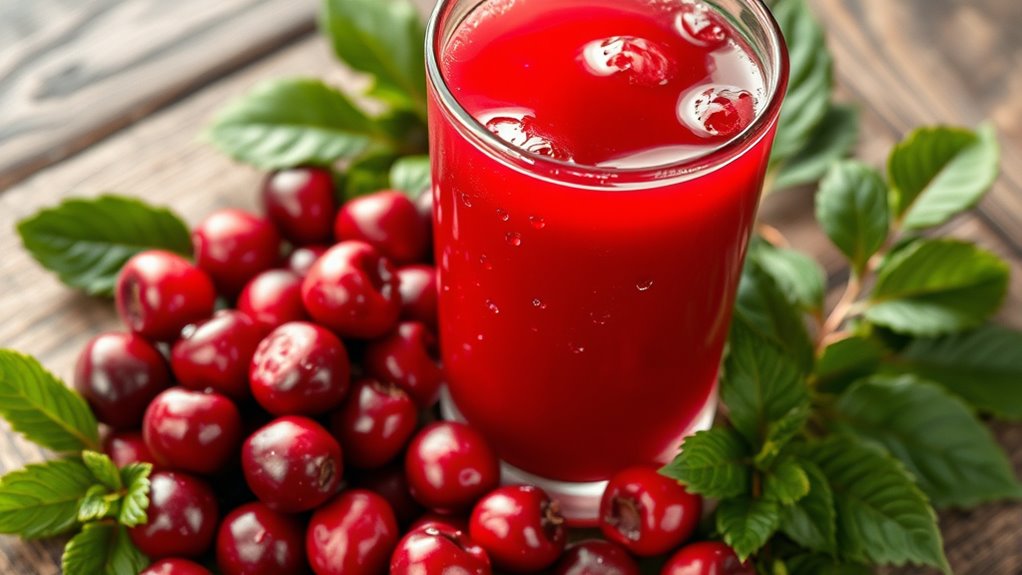
Cranberry juice can reduce your risk of symptomatic urinary tract infections (UTIs) by about 40% by preventing bacteria, especially *E. coli*, from sticking to the bladder wall.
This effect stems mainly from A-type proanthocyanidins (PACs) in cranberries, which inhibit bacterial adhesion rather than killing bacteria directly. Fructose also assists by enhancing this anti-adhesive action.
Consistent cranberry juice consumption over time supports bacterial clearance and reduces infection risk. However, the active compound concentration varies widely in commercial juices, often falling below effective levels. Women have a 50% chance of experiencing a bladder infection in their lifetime, making prevention especially important.
While cranberry juice shows promise for preventing UTIs, it’s not a treatment for active infections. For stronger effects, cranberry supplements delivering standardized PAC doses may be more effective.
Still, research presents mixed results, and appropriate dosing remains under evaluation, making cranberry a complementary preventive option rather than a standalone solution.
Lemonade as a Kidney Stone Preventative
While cranberry juice supports urinary tract health by preventing certain infections, other fruit-based beverages like lemonade play a significant role in kidney stone prevention.
Lemonade made from real lemon juice raises urinary citrate, a natural inhibitor of stone formation, without altering urine pH. Diet lemonade, being low-calorie and sugar-free, increases urinary citrate more effectively than regular versions, reducing calcium oxalate and phosphate supersaturation. It is important to note that aiming for sufficient hydration by increasing fluid intake helps to dilute urine of stone-forming minerals and reduce the likelihood of stone formation.
Real lemon juice and diet lemonade boost urinary citrate, helping prevent kidney stone formation effectively.
Both raise urine volume, diluting minerals that form stones. Fresh lemon juice supplementation shows potential to lower stone recurrence, especially with adherence, but long-term compliance is essential.
Since excess sugar may increase stone risk, sugar-free or homemade lemonade with controlled sweetener is preferable. Individual urine chemistry varies, so a 24-hour urine test helps tailor lemonade use within a balanced diet for best kidney stone prevention.
Orange Juice to Increase Urinary Citrate
Because orange juice contains potassium citrate, it primarily boosts urinary citrate levels and raises urine pH, both critical factors in reducing kidney stone risk.
Studies show orange juice can increase urinary citrate excretion from about 571 to 952 mg/day and raise urine pH from roughly 5.7 to 6.5, creating an alkalinizing effect that discourages stone formation.
This alkalinization results from citrate metabolism into bicarbonate, delivering an alkali load similar to potassium citrate supplements.
Unlike lemonade, orange juice provides citrate in potassium-complexed form, enhancing urinary citrate more effectively.
However, orange juice may raise urinary oxalate, so moderation is key.
Grape Juice for Moderate Potassium Intake
Orange juice effectively boosts urinary citrate but comes with a higher potassium load, which may not suit everyone managing kidney health.
Grape juice offers a moderate potassium option, containing about 140 mg per cup, well below orange juice’s 450 mg. This makes it suitable if you need to control potassium intake but still want the benefits of fruit juice.
Grapes and their juice provide antioxidant phytochemicals like anthocyanins and resveratrol, supporting cardiovascular health and potentially reducing inflammation—important for kidney patients.
You should monitor portions carefully, as multiple servings can increase potassium levels. Choose grape juices without potassium additives to limit excessive intake.
Always discuss your potassium goals and juice consumption with your healthcare provider to ascertain it fits your specific kidney health needs.
Apple Juice as a Low-Potassium Fruit Option
Apple juice offers a practical choice for those seeking a low-potassium fruit juice option, containing about 240 mg of potassium per cup—significantly less than juices like orange or pineapple.
For kidney health, especially in managing chronic kidney disease (CKD), apple juice provides hydration and nutrients without excessively raising potassium levels.
To safely incorporate apple juice into your diet, consider these points:
- Opt for 100% pure apple juice with no added potassium preservatives.
- Limit serving sizes to ½ to 1 cup to control potassium intake.
- Avoid large quantities to prevent potassium overload.
- Use apple juice as a substitute for higher-potassium juices.
- Coordinate intake with your healthcare provider for personalized guidance.
This approach helps you enjoy apple juice while maintaining suitable potassium levels for kidney health.
Pineapple Juice: Benefits and Potassium Considerations

Pineapple juice offers several benefits that support kidney health while maintaining relatively low potassium levels, making it a viable choice for individuals managing chronic kidney disease.
It contains bromelain, an enzyme with anti-inflammatory properties that may help reduce kidney inflammation and oxidative stress. Additionally, pineapple juice is low in potassium—about 160 mg per 4-ounce serving—making it safer for those who must monitor potassium intake.
It also promotes hydration and toxin removal, which supports kidney function. When adding pineapple juice to your diet, choose fresh juice over canned varieties to maximize bromelain content and avoid added sugars.
Always consult your healthcare provider before regular consumption to verify it aligns with your individual potassium restrictions and overall kidney health management plan.
Juices Rich in Antioxidants to Reduce Kidney Inflammation
While managing kidney health, incorporating juices rich in antioxidants can play an essential role in reducing inflammation and oxidative stress.
These juices help protect kidney tissue by neutralizing harmful free radicals and lowering inflammatory processes, which are vital for preventing further kidney damage.
They protect kidney tissue by neutralizing free radicals and reducing inflammation, crucial for preventing damage.
You might consider adding these antioxidant-rich juices to your diet:
- Cranberry juice, which contains proanthocyanidin type A that reduces bacterial adhesion and inflammation.
- Beet juice, rich in betalains and vitamin C, supports kidney function and reduces oxidative stress.
- Blueberry juice, abundant in anthocyanins, helps lower inflammation and CKD progression.
- Green tea, with catechins that slow kidney damage and reduce oxidative markers.
- Pomegranate juice, high in polyphenols, which counters oxidative stress and improves kidney markers.
Moderation and unsweetened options are key for kidney safety.
Carrot and Celery Juice for Nutrient Balance
Adding juices like carrot and celery to your diet can help maintain a balanced nutrient profile supportive of kidney health.
Carrot juice delivers antioxidants that reduce oxidative stress, while celery juice provides essential vitamins like K, C, potassium, and folate, aiding nutrient balance. Both are low-calorie, low-sugar options packed with vitamins A and C, and antioxidant compounds that reduce inflammation and may protect kidney tissue.
Celery juice’s high water content supports hydration, vital for waste excretion and blood pressure regulation—key factors in kidney function.
However, moderate consumption is important, especially for those with chronic kidney disease, due to potassium content. Limit servings to under 8 ounces and consult a dietitian to safely include these juices in your kidney health regimen.
Berry-Based Juices for Kidney Protection
Because of their potent antioxidant and anti-inflammatory properties, berry-based juices like blueberry and cranberry have gained attention for kidney protection.
Blueberry juice supports kidney health by lowering oxidative stress, improving filtration rates, and regulating systems linked to renal injury.
Cranberry juice, rich in polyphenols, may reduce inflammation and urinary tract infections, indirectly benefiting kidneys. However, if you’re prone to kidney stones, especially calcium oxalate types, you should use cranberry juice cautiously due to its oxalate content and potential to acidify urine.
When considering these juices:
- Blueberry reduces TLR4 expression linked to kidney damage
- Cranberry polyphenols inhibit urinary infections
- Avoid high-sugar cranberry juices to protect renal function
- Cranberry’s impact on stone risk remains unclear, so consult healthcare providers
- Both juices offer complementary antioxidant benefits for chronic kidney disease management
Herbal and Green Juices to Support Kidney Function
When you incorporate herbal and green juices into your routine, you tap into powerful natural compounds that support kidney function through antioxidant, anti-inflammatory, and diuretic effects.
Parsley-based juices promote antioxidant defense, reduce oxidative stress, and enhance cellular repair, easing recovery from kidney injury.
Parsley juices boost antioxidant defense, lessen oxidative stress, and support cell repair for kidney recovery.
Beetroot juice lowers markers like serum creatinine and inflammatory cytokines while protecting against renal fibrosis and podocyte apoptosis.
Green juices containing nettle reduce tubular atrophy and glomerular shrinkage and help prevent fibrosis, though professional supervision is essential due to potential interactions.
Additionally, herbal extracts such as Coptis rhizome and Sanghuang inhibit pro-inflammatory pathways, lowering kidney inflammation and fibrosis.
Conclusion
You don’t have to search far and wide to support your kidney health—these juices act like nature’s gentle guardians. By incorporating cranberry, lemonade, orange, and other nutrient-rich juices into your routine, you’re giving your kidneys the antioxidants, vitamins, and minerals they need to stay strong and reduce inflammation. Remember, balancing potassium and citrate levels helps prevent stones and protects kidney function, proving that what you drink truly shapes your kidney’s future health.