
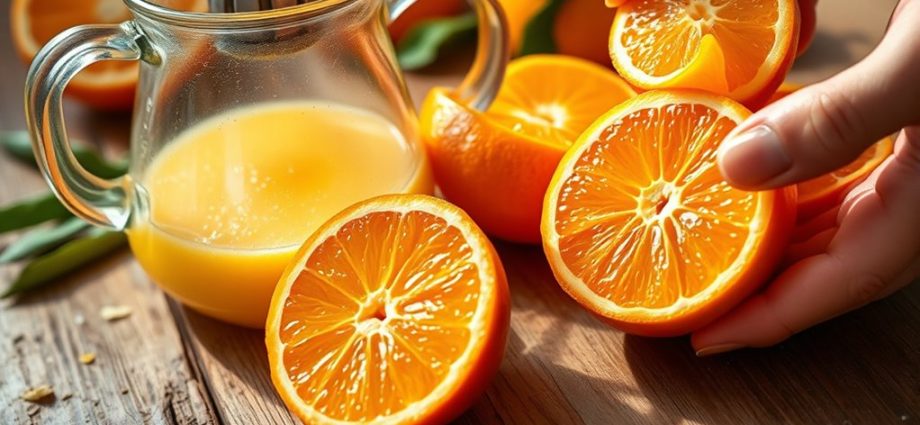
You start by harvesting oranges promptly and transporting them to nearby processing plants. Then, you sort and clean the fruit to remove dirt and residues using mild solutions and brushes. Next, you mechanically press the oranges, extracting juice without adding water. You separate seeds and excess peel oil to avoid bitterness. Finally, you filter and pasteurize the juice quickly to preserve flavor and extend shelf life. This process guarantees fresh, natural juice, and there’s more detail about each step to explore.
Although orange harvesting spans several months from October to June, producers prioritize immediate transport of freshly picked fruit to processing facilities to preserve quality. You’ll find that this rapid transfer is essential to maintaining the fruit’s freshness and minimizing degradation. Whether harvested by hand in smaller groves or mechanically in larger operations, oranges are swiftly moved to minimize exposure to environmental factors that compromise quality. Orange processing plants are strategically located near fruit-growing areas for prompt processing post-harvest.
Upon arrival, the fruit undergoes rigorous sorting where any damaged, rotten, or substandard oranges are removed, ensuring only the best quality produce proceeds. The cleaning process then employs a combination of spraying and scrubbing using water and mild alkaline solutions, efficiently eliminating dirt, pesticide residues, and surface contaminants. High-pressure nozzles complemented by rotating brushes guarantee complete and gentle cleansing of the outer peel, avoiding harm to the fruit while preparing it for extraction.
Next, you’ll see the juice extraction phase, where the oranges are sliced mechanically, often by rotary presses that halve the fruit and press out the juice while concurrently separating peel and core components. During pressing, pins or sharp instruments puncture the peel to release natural oils important for flavor enhancement, although excessive oil must later be removed to prevent off-flavors. This extraction avoids adding water, thereby preserving the juice’s natural concentration and reducing energy expenditures by eliminating the need for dilution and reprocessing. Proper extraction impacts product quality; thus, fruit must be sorted by size to optimize extractor performance juice extraction optimization.
After extraction, the juice undergoes separation to remove husks, seeds, and excess peel fragments to limit bitterness and to achieve the desired pulp content. This stage results in juice with lower limonin levels, which reduces bitterness, and maintains higher levels of intact juice cells, providing superior texture and quality.
You’ll also notice that peel oil, mainly d-limonene, extracted during pressing, requires careful removal. Excessive peel oil causes undesirable flavors, so oil is removed by washing peel fragments with recycled water followed by centrifugal separation. Degreasing happens concurrently with degassing, tightly controlling citrus peel oil levels to balance taste without sacrificing key volatile flavor compounds.
The system recovers essential oils during evaporation or vacuum processes, preserving aroma profiles while removing impurities. This oil management improves flavor stability and extends shelf life, which is fundamental for maintaining product acceptability over time.
Once oils are controlled, the juice is filtered and clarified to remove residual pulp, seeds, and suspended solids—this enhances clarity and smoothness. Clarification reduces viscosity and bitterness while retaining some pulp particles to uphold mouthfeel.
Depending on the desired product type, centrifugal processes may be used to separate floating pulp, with the option to reintroduce pulp to achieve natural content specifications. Maintaining solids and fiber within targeted ranges allows manufacturers to meet consumer demands for no pulp or pulp-added orange juice variations.
Finally, you’d see pasteurization as a essential safety and preservation step. Heat treatment typically involves heating the juice to 91-95°C for 15-30 seconds or alternatively to over 120°C for 3-10 seconds. This process inactivates spoilage bacteria and enzymes, significantly extending shelf life without significant flavor loss.
Flash pasteurization is preferred for its efficacy and minimal sensory impact. During pasteurization, holding tanks keep the juice at uniform temperature, ensuring microbial safety across the entire batch. This control point complies with strict food safety standards, securing the juice’s quality for consumers.
Through these technically precise and carefully engineered steps, the natural essence and revitalizing quality of orange juice are preserved from grove to glass.
Conclusion
Now, imagine the cascade of freshly squeezed orange juice—each drop bursting with vibrant flavor and nutrients. You’ve seen how the fruit’s journey, from careful selection to gentle extraction and swift pasteurization, preserves its natural essence. As you pour that glass, remember: you’re holding a complex symphony of science and nature, perfectly balanced to deliver purity and taste. The next sip will reveal the meticulous craftsmanship behind every revitalizing drop.